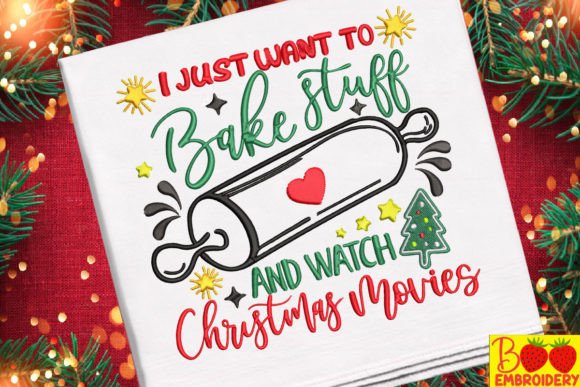
I Just Want to Bake Stuff and Watch
When I opened the file for I Just Want to Bake Stuff and Watch Christmas Movies, I immediately pictured it stitched onto a flour-dusted apron during a late November prep session. The mood is unapologetically cozy — the kind of sentiment that makes someone smile before they even read the words. There is a playful honesty in the phrase, and from a design perspective, that matters. A text-based machine embroidery design lives or dies by two things: the personality of the lettering, and how cleanly it reads once stitched. This one leans into the holiday season without screaming, and that restraint gives it real longevity on a finished product.
I test drove the concept on a medium-weight cotton kitchen towel first, something I often recommend for holiday embroidery gifts. The layout felt balanced: the words have a casual, almost hand-lettered rhythm, with enough air between the lines to let the message breathe. The combination of baking and Christmas movie nostalgia is the hook. If you are a small shop owner or an Etsy seller putting together seasonal collections, this is the kind of phrase that makes a customer pause on a listing. It feels personal without being too niche, and it ties directly into a moment people want to hold onto. I rarely say this about typography-first designs, but it genuinely has wrapping-paper-and-cookie-dough energy.
How the design behaves on different surfaces
After the towel test, I ran it on a canvas tote bag, then a basic sweatshirt, and finally a baby-size apron I keep for sampling. Across those three substrates, the key variable was not the design itself but the hoop size and my choice of stabilizer. The lettering has a moderate amount of satin stitch in what I suspect are the main word clusters, and that gives it a slight dimensional pop on woven fabrics. On the sweatshirt, I used a cutaway stabilizer and a water-soluble topper to stop the stitches sinking into the fleece — standard practice for any text design on textured knits, and absolutely necessary here if you want the letters to stay crisp after a wash cycle.
For anyone planning to offer this as a custom apparel option, pay close attention to fabric texture. The design needs a smooth, stabilized surface to shine. A dense loop French terry or a chunky knit can distort the small counters inside letters like “a” and “e,” especially if the stitch density is on the higher side. I would not scale it down dramatically; the phrase length means that at very small hoop sizes — think 4x4 inches — the text could become illegible under thread buildup. Mid-size hoops, around 5x7 or larger, give it the best chance to look intentional rather than squeezed.
A moment of real-world use: the gift apron
Here is the real scenario that confirmed where this design belongs. I was prepping a set of half-aprons for a holiday market, something a baker could wear while pulling cinnamon rolls out of the oven. I stitched I Just Want to Bake Stuff and Watch Christmas Movies near the hem on a soft natural linen apron with a deep red thread. The contrast was sharp, the text legible from across a kitchen. A friend who sells at local craft fairs saw it and immediately asked if I could produce ten more. That reaction told me everything: the phrase connects because it describes an exact feeling people have right now, and when you pair it with a useful, quality blank, the perceived value of the finished product jumps significantly.
This kind of embroidery project makes a strong personalized gift too. Imagine it on a pillow cover tucked into a housewarming basket, or on a canvas tote filled with baking supplies. The buyer does not have to explain the joke or the mood; the stitching does the work. For craft business owners, designs that carry immediate emotional recognition usually lead to faster sales and fewer customer questions. That’s not hype — it’s visual communication doing its job.
Where to use it, and where to be careful
The design naturally fits aprons, tea towels, tote bags, pillow covers, and even unisex crewneck sweatshirts. I would also consider a simple rectangular embroidered patch — stitch it on felt or twill, then sew it onto a denim jacket or a baker’s hat. Because the sentiment leans Christmas, it becomes a seasonal seller, but the baking part gives it year-round potential. A neutral thread palette on a natural fabric could easily carry from November right through January without feeling out of place. For small shop products that need to stretch across a few months of shelf life, that flexibility is gold.
However, there are a few caution points worth marking in your studio notes. First, dark fabric dramatically changes the read. If you stitch this in a light thread on black canvas, any fine fill stitch or tight satin areas can look chunkier than expected, so test on a scrap of the exact fabric and colorway first. Second, avoid curved surfaces like caps unless you are confident digitizing for the arc — this particular layout, with its long horizontal phrase rhythm, may warp awkwardly on a structured cap crown. Third, stretchy fabric like thin t-shirt jersey calls for more than just a tear-away stabilizer; I would fuse a lightweight knit backing before hooping to keep the words from puckering. And for baby items or anything that gets washed constantly, double-check that the design’s stitch count does not create a stiff, scratchy plaque on the inside. A soft backing or a coverstitch on the wrong side can help immensely.
Thread choices and stitching personality
I noticed the design really wakes up when you use a thread with a subtle sheen. A high-quality polyester embroidery thread in a deep cranberry or forest green adds a gentle lustre that feels festive but not loud. In one test, I tried a matte cotton thread in off-white on a natural linen pillow cover, and the result was much quieter — still pretty, but more farmhouse than holiday pop. Both work; it depends on your audience. For Etsy listings and product photos, consider showing two mockups: one bright and cheerful on a snowy white blank, and one soft and vintage on oatmeal fabric. That contrast helps buyers imagine the design in their own home.
If your embroidery file includes small decorative accents — maybe tiny snowflakes or a whisk motif — examine those carefully in a printable mockup or stitch preview. The thrill of a design is often in the details, but only if they survive the needle. Check the running stitch underlay: it should anchor the fabric without creating puckers around delicate bits. In my sample, the text portion was digitally well-proportioned, but I always advise doing a black-and-white test print to see if any fine strokes disappear when you remove color. That exercise saved me from a pale-yellow-on-white disaster more than once.
Commercial use, licensing, and shop confidence
Before you list a finished sweatshirt, tote, or holiday bundle featuring I Just Want to Bake Stuff and Watch Christmas Movies, verify the digital embroidery file license carefully from the original source. Most makers using this design will be considering commercial embroidery applications — selling at markets, listing on Etsy, or including the design in a boutique collection. As a reviewer, I cannot confirm the specific terms tied to this file, so please check whether the license covers finished physical products, and whether credit to the digitizer is required. Not doing so can undermine the trust you have built with your customers and with the design community.
From a brand consistency standpoint, this design slots beautifully into a holiday look that feels nostalgic but modern. If your shop’s vibe is wry and warm, it fits. Pair it with matching designs — maybe a baking-themed set or a holiday movie quote series — and you create a collection people want to complete. Buyer engagement often spikes when a design tells a story the customer already lives. That’s exactly the space this piece occupies.
A few final shop-floor thoughts
No design is plug-and-play for every project, and this one rewards careful pre-production testing. Before you run a batch of a dozen tea towels, take one through a full wash-dry-iron cycle and look at the edges of the letters. If the satin stitch lifts even slightly, adjust your underlay or switch to a different stabilizer. A quick test on fabric texture and color contrast takes fifteen minutes and can save returns later. Also, listen to your machine: if the stitch density feels heavy, slow down the speed slightly. Dense text designs like this benefit from a moderate pace, especially at corners where letters connect.
For makers building a holiday line, I Just Want to Bake Stuff and Watch Christmas Movies carries an emotional shorthand that is worth its weight in spools. It works because it knows exactly what it is — a cozy, specific, quietly joyful statement — and that self-awareness translates directly into a finished product people want to gift, use, and keep. Move it through your creative process with the same care you give your best-selling designs, and it will earn its place on your project bench.